
The Journalist's Guide to UGC Rights Clearance
Everything journalists and producers need to know about clearing user-generated content - from who owns it, to when to license it, to how to protect yourself legally.
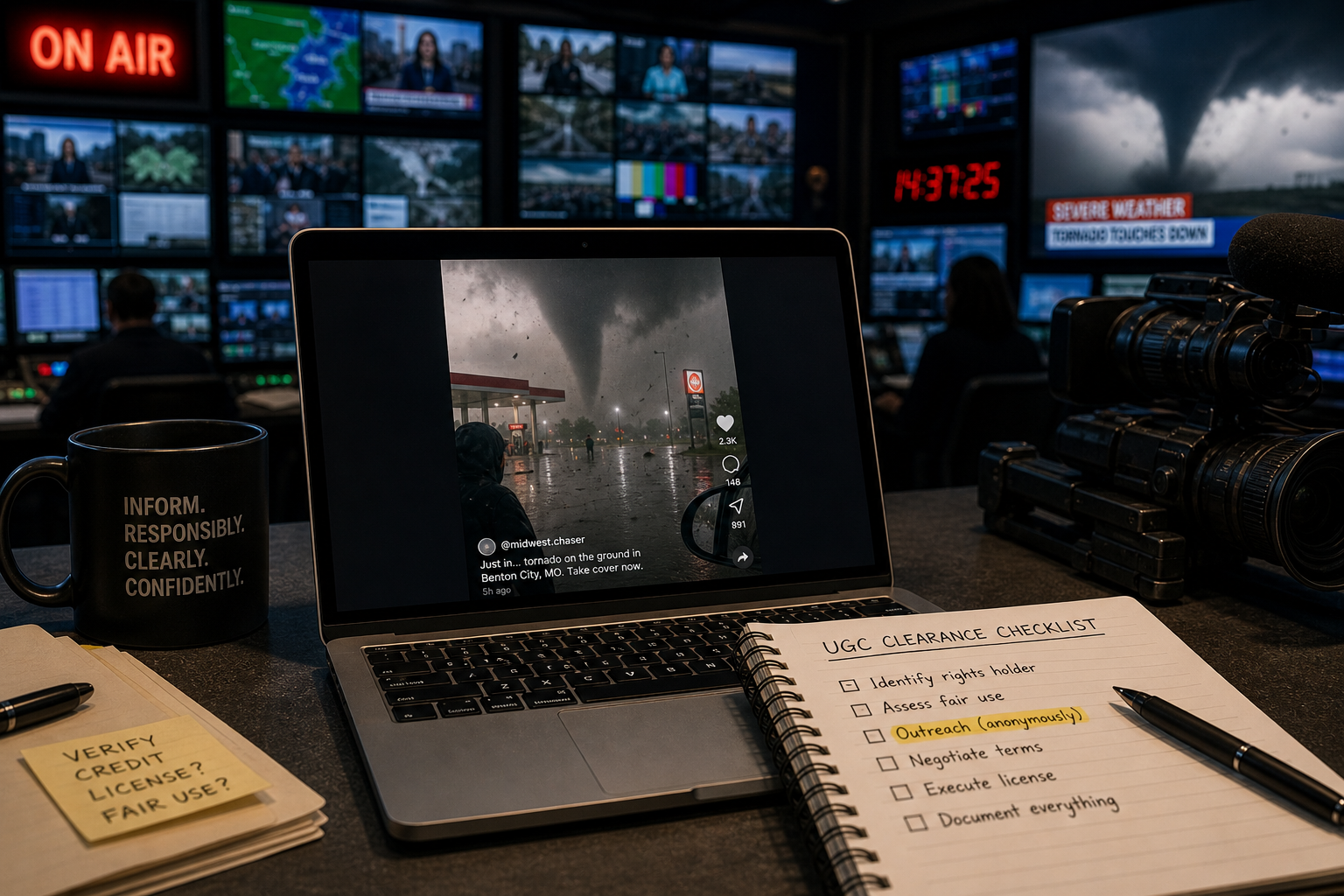
What to know before you go to air with someone else’s content
User-generated content has reshaped journalism. Some of the most important footage in the last decade wasn’t shot by a crew. It was captured by someone who happened to be there, phone in hand.
That access is powerful. It’s also risky.
Because using someone else’s content isn’t as simple as embedding a post or dropping a clip into your edit.
What counts as UGC and why it matters legally
User-generated content (UGC) is any video, photo, or audio created and posted by an individual, usually on platforms like TikTok, Instagram, or X.
Here’s the part that trips people up:
Copyright attaches automatically.
The moment someone records and posts a clip, they own it. No watermark. No registration. No © symbol required.
So if you download it, edit it, air it, or even use it outside the platform it was posted on, you’re using someone else’s copyrighted material. And unless you have permission, or a solid fair use argument, you’re taking legal risk.
Fair use is never a slam dunk.
Fair use comes up in almost every newsroom conversation about UGC. It’s also widely misunderstood.
At its core, fair use is a defense, not a permission slip. You don’t “have” fair use. You argue it if you’re challenged.
Courts look at four factors:
Purpose and character – Are you transforming the content, or just republishing it?
Nature of the work – Is it factual footage or something more creative?
Amount used – Are you using only what’s necessary?
Market effect – Would your use undermine the creator’s ability to license it?
There’s no bright line. Two reasonable lawyers can disagree on the same clip.
And you only find out who’s right if there’s a claim.
The real-world dilemma: reach out or don’t?
In theory, the decision tree is simple:
If fair use is strong → use it
If fair use is weak → license it
In practice, it’s messier.
Because reaching out to a rights holder can create its own problems:
-If no deal is reached, you've now tipped off the creator to your intended use, increasing the likelihood that they'll bring a claim.
-If negotiations proceed, the creator may try to inflate the price based on your outlet's perceived budget.
-Outreach itself can slow you down when timing matters most
So teams end up in a bind:
Reach out and risk exposure, or don’t reach out and accept uncertainty.
When fair use may be enough
In practice, fair use tends to be stronger when:
-You’re using short excerpts
-The use is tied directly to reporting or commentary on the event itself
-The footage is primarily factual
-There’s no realistic licensing market for the clip
Even then, it’s a judgment call, not a guarantee.
When you should seriously consider licensing
Licensing is the safer route when:
-The clip is a centerpiece of your story
-It’s going out nationally or across multiple platforms
-You plan to reuse it (broadcast, digital, promos, social)
-Legal or standards teams are uneasy calling it fair use
-The more valuable the clip is to you, the more sense it makes to lock it down.
What a real license should cover
A quick “yes, you can use it” in the comments isn’t enough.
A proper license should spell out:
-Who can use the content
-What content is covered
-How it can be used (edit rights, context, etc.)
-Where it can appear (TV, web, social, worldwide vs. domestic)
-How long you can use it
-Payment terms
-A representation from the creator that they actually own the content
If any of that is unclear, you don’t really have a clean license.
Documentation: your quiet best friend
Whether you’re relying on fair use or a license, documentation is what protects you later.
At minimum:
-Screenshot the original post (with timestamp, username, and URL)
-Save your outreach messages and replies
-Keep executed licenses in an accessible place
-If relying on fair use, write down your editorial reasoning at the time
This is the kind of stuff you’ll never need...until you do.
Where workflows break down
Most newsroom issues with UGC don’t come from misunderstanding the law.
They come from friction:
-Outreach happens in DMs, email, and comments
-Terms get negotiated informally (or not at all)
-Approvals are scattered across Slack, texts, and inboxes
-Documentation is inconsistent or lost
-Everyone is moving fast. The process isn’t.
A better way to handle UGC clearance
The organizations that handle UGC well don’t just rely on judgment. They rely on systems.
They’ve adopted workflows that let them:
-Reach out quickly, without creating unnecessary exposure
-Negotiate terms clearly and consistently
-Execute licenses without slowing down production
-Keep a clean record of every decision and agreement
Increasingly, that means using the right tools.
A note on tools
If you’ve ever tried to clear UGC under deadline, you already know the pain points: fragmented outreach, unclear permissions, and messy documentation.
But there’s another issue that’s easier to miss and harder to solve:
Traditional outreach can create risk.
Reaching out to a rights holder can:
-Tip them off to your intended use, making a claim more likely if no deal is made
-Result in inflated pricing based on your outlet's perceived budget.
-Force a decision between speed, price, and legal exposure
These are exactly the problems Chauncy is built to solve.
Chauncy doesn’t just streamline the workflow. It enables confidential outreach, allowing journalists to explore licensing, negotiate terms, and secure rights (or decide to rely on fair use) without immediately revealing their identity or editorial plans.
The goal isn’t to replace your editorial and business judgment. It’s to let you exercise that judgment without unnecessary exposure.
The bottom line
In a fast-moving newsroom, you can't eliminate risk entirely.
But with the right tools, you can make smarter, faster, and more defensible decisions, and have the processes and documentation to back them up later.